Sales Pipeline Leakage: How to Find and Fix B2B Pipeline Leaks
Audit sales pipeline leakage with a consistent cohort, a worked B2B example, and an evidence-based worksheet. Separate missed commitments from valid losses.
By Can Buyuk on October 22, 2026
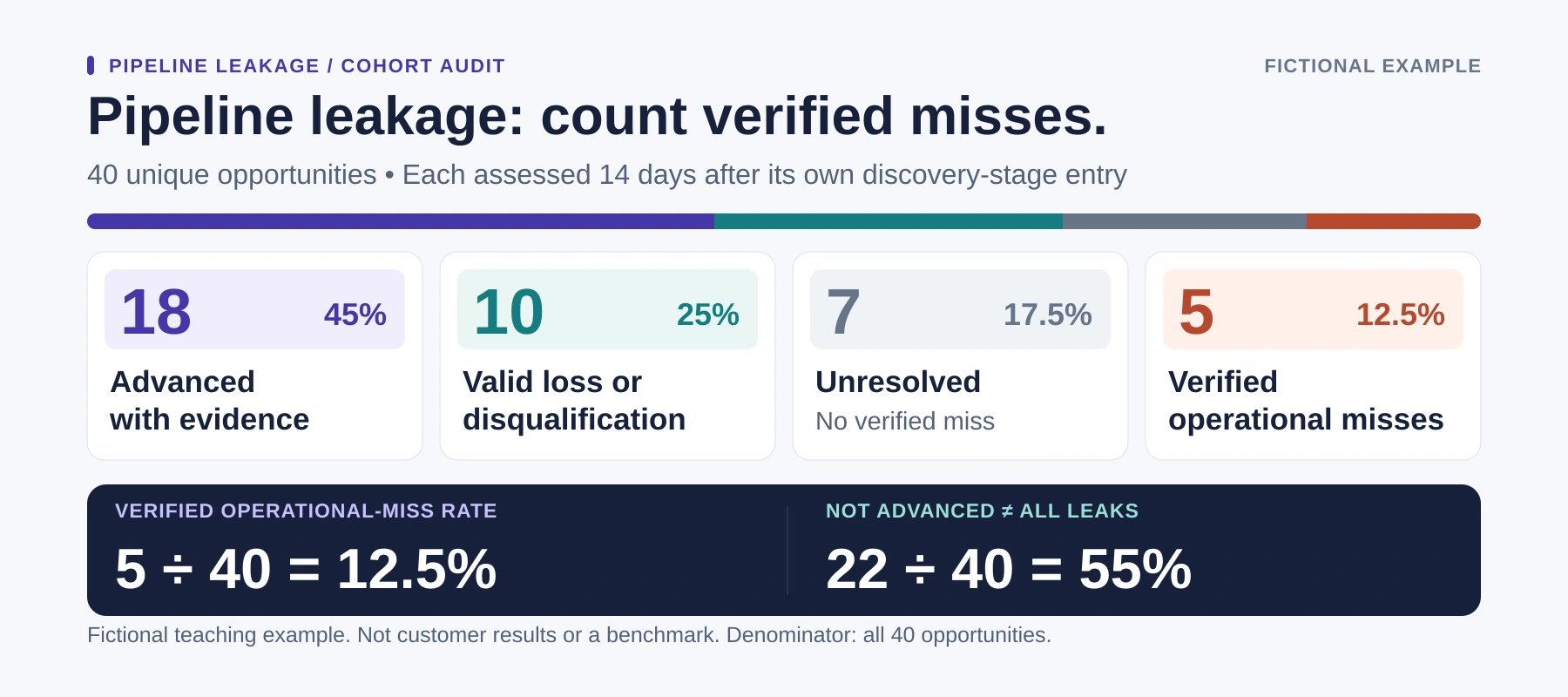
Sales pipeline leakage is the loss of otherwise viable opportunities through preventable execution gaps: a promised follow-up never happens, a qualified opportunity has no accountable owner, or a next step disappears between tools. A buyer choosing another supplier is a different problem. So is a deal that is still progressing on an agreed timeline.
For B2B sales leaders in 10–250-person companies, the useful question is: which opportunities failed to progress because an internal commitment was missed, and what evidence supports that conclusion? This guide provides a cohort-based audit, a fictional worked example, and a worksheet for turning findings into owned fixes.
What counts as sales pipeline leakage?
Use a narrow operational definition: a verified execution failure affecting an opportunity that has not made the expected transition. It identifies work to repair without pretending to prove that the failure caused a lost sale.
Salesforce’s healthy-pipeline guidance describes prospects progressing within an appropriate timeframe or being filtered out. That distinction matters: good qualification deliberately removes poor-fit opportunities. Treating every departure as leakage can encourage reps to keep unsuitable deals open.
Separate these situations before calculating a rate:
- Legitimate loss or disqualification: the buyer declines, the product cannot meet a requirement, or qualification reveals no viable project. Preserve the reason and its evidence.
- Unresolved opportunity: the outcome is not yet known. It may have a credible future commitment, or it may need investigation because the record is incomplete.
- Verified operational miss: a required internal action was overdue and confirmed incomplete, such as an accepted request for technical information that nobody delivered.
Age is a review signal. An empty activity field is a data-quality signal. Neither alone establishes an execution failure.
Build a cohort before measuring leakage
A cohort is a defined group of opportunities that entered the same stage during the same period. Follow those records through a consistent observation window. Comparing this month’s discovery count with this month’s proposal count mixes opportunities of different ages and can produce a misleading conversion rate.
1. Choose one transition and one counting unit
Start with a specific transition, such as discovery to a buyer-agreed evaluation. Define evidence of advancement before reviewing results. “Proposal sent” and “buyer agreed to evaluate” describe different events.
Count unique opportunities, rather than mixing contacts, accounts, and deals. HubSpot’s lifecycle-stage documentation explains that lifecycle stages categorize contacts and companies; its Opportunity lifecycle stage means association with a deal. That is not automatically evidence that the deal completed your discovery exit criteria.
Deduplicate before freezing the cohort. Decide how stage skips and re-entry are handled. For a first audit, count the first qualifying entry once and flag later re-entry separately.
2. Give every record the same observation window
Choose a window that fits this transition and sales motion. Fourteen days is used below only to make the example concrete; it is not an industry benchmark or a universal follow-up deadline.
Evaluate each opportunity at the same elapsed time after stage entry. An opportunity entering on September 1 reaches its 14-day cutoff on September 15; one entering on September 7 reaches it on September 21. Use a consistent timezone and timestamp rule.
Wait until the last record has reached its cutoff. Keep newer, immature records in a separate monitoring view rather than treating them as failures. Reconstruct what was known by each cutoff from history, not just today’s stage.
3. Establish what your evidence can support
Export the opportunity ID, stage-entry timestamp, transition history, owner, last buyer interaction, promised next action, due date, and any closure reason. Link supporting notes, messages, or task records within your authorized systems.
If history is unavailable, label the audit incomplete and begin collecting it. A current CRM snapshot cannot by itself establish when an earlier transition occurred. Check recording gaps with the owner before classifying a missing log as missed work.
A fictional sales pipeline leakage example
Illustrative example, not a customer case or reported result: a fictional B2B software team reviews 40 unique opportunities that first entered discovery during September 1–7, 2026. Every record receives exactly 14 days of observation.
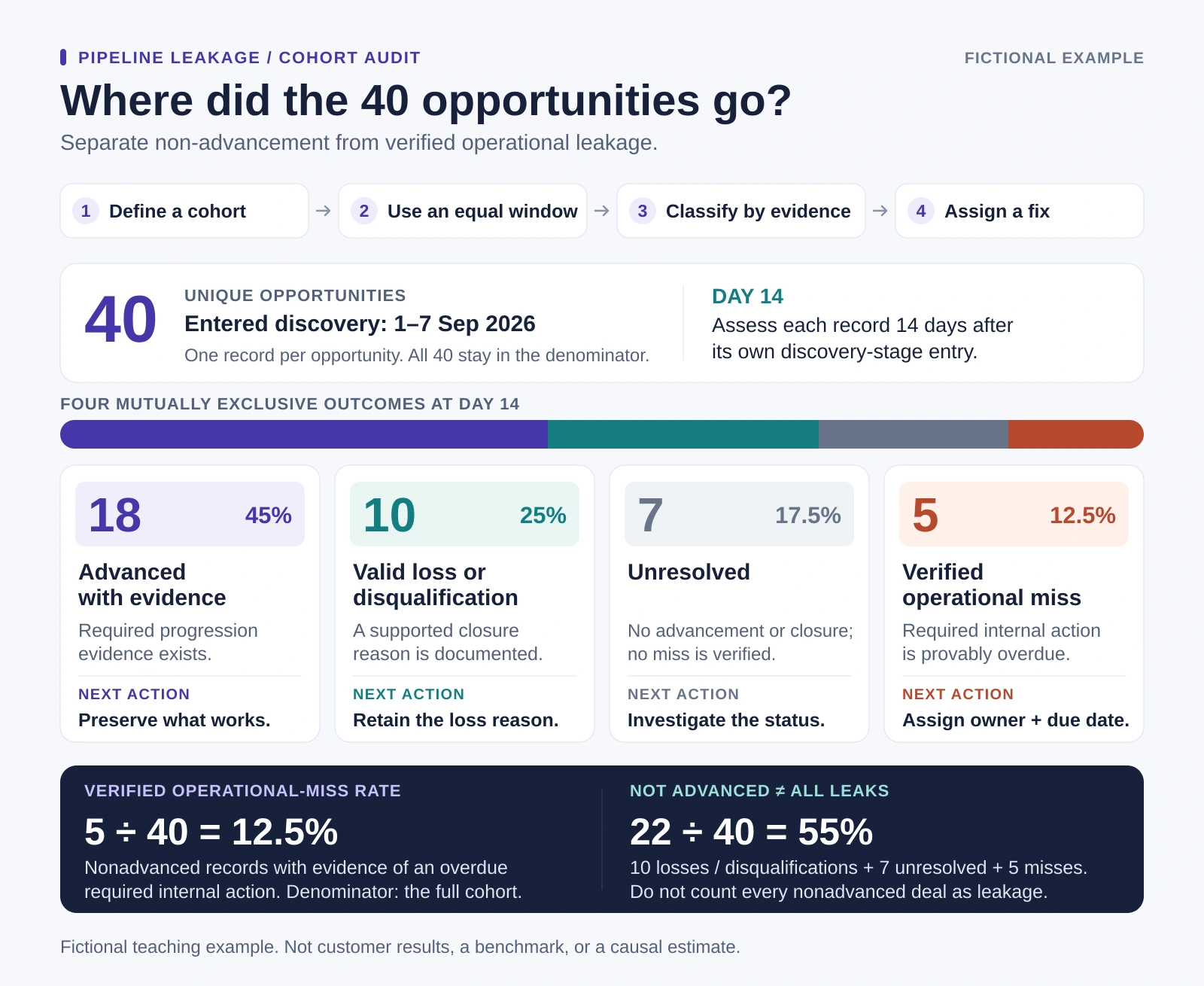
View the full cohort audit diagram for the fictional 40-opportunity example.
Its exit criterion is documented buyer agreement to an evaluation with an owner and next step. The team applies four mutually exclusive categories:
| Status at the cutoff | Count | Share |
|---|---|---|
| Advanced within 14 days | 18 | 45% |
| Valid loss or disqualification | 10 | 25% |
| Unresolved | 7 | 17.5% |
| Verified operational miss | 5 | 12.5% |
Classify each record against an evidence standard:
- Advanced: the defined transition occurred before the cutoff.
- Valid loss: no advancement; a supported closure reason was recorded by the cutoff.
- Unresolved: no advancement or supported closure; no verified overdue internal obligation.
- Operational miss: no advancement or supported closure; required internal work was verified overdue and incomplete.
Apply advancement first, then supported closure, then the operational-miss test; the remaining records are unresolved. This prevents double-counting. An opportunity that advanced and later lost still counts as having completed this transition. Track its later outcome separately.
14-day transition rate = 18 ÷ 40 = 45%.
Verified operational-miss rate = 5 ÷ 40 = 12.5%.
The denominator is all eligible opportunities in the mature cohort, including legitimate losses and unresolved records. Dividing five by the 22 non-advancing opportunities answers a different question: the share of non-advancers with verified misses.
Likewise, 22 ÷ 40 = 55% measures non-advancement within the window. Calling that a 55% leakage rate would combine valid disqualification, ongoing work, uncertainty, and execution failures.
Record operational problems on advanced or closed opportunities as secondary flags. The four-way audit is a prioritized snapshot, not a complete count of every process defect. The five misses also do not represent five recoverable customers or a proven amount of lost revenue.
Use a worksheet that leads to a decision
Create one row per opportunity with these fields: ID, cohort entry, cutoff, advancement evidence, closure evidence, next commitment, accountable owner, due date, completion evidence, classification, corrective action, and review date.
The following records are fictional examples of how to use those fields, not additional opportunities beyond the 40 above.
D-07: promised technical answer not delivered
- Owner and timing: account executive; answer due September 5.
- Evidence: buyer request, accepted commitment, and owner confirmation that it remained incomplete at cutoff.
- Decision: operational miss. Confirm whether the answer is still useful, then complete the approved follow-up.
D-19: required deployment model unavailable
- Owner and timing: account executive; review completed September 8.
- Evidence: documented requirement and confirmed product limitation.
- Decision: valid disqualification. Close with the specific reason; do not keep chasing.
D-28: buyer scheduled a later review
- Owner and timing: account executive; next discussion agreed for September 28.
- Evidence: buyer confirmation, future meeting, and no overdue seller commitment.
- Decision: unresolved at day 14. Preserve the agreed next step instead of inventing urgency.
D-36: next-step history missing
- Owner and timing: sales manager; assign an investigation date.
- Evidence: owner interview, permitted meeting notes, and message history.
- Decision: unresolved pending evidence. Repair the record before judging execution.
Keep “unknown” visible. Reclassifying every ambiguous record as leakage exaggerates the problem; assuming every ambiguity is healthy hides it. Set an owner and review date for the investigation itself.
Fix the failure you can verify
Group confirmed misses by the mechanism that failed: assignment, commitment capture, task execution, escalation, or record synchronization. Choose a small, inspectable correction rather than rebuilding the whole sales process.
- Unowned work: name an accountable owner and an exception path when that person cannot act. Review whether the assignment was accepted.
- Forgotten commitments: turn an agreed action into a dated task with completion evidence. A reminder firing is not proof the work happened.
- Conflicting records: decide which system owns the field and investigate synchronization failures before adding another update rule.
- Legitimate waiting: retain the buyer’s agreed timing. Additional outreach can be inappropriate when a next discussion is already scheduled.
For the implementation details behind routing and ownership, see sales handoff automation. For field ownership and change controls, see AI CRM automation. Use this audit to decide which problem needs attention first.
Assign each correction an owner, due date, and acceptance test. For example: “Sales operations verifies that the next eligible handoff has an accepted owner, a dated task, and evidence of completion.” Keep overdue exceptions visible even when an automation reports success.
Where Vera can support the review
Vera is GrowthEffect’s AI sales agent, working across sales tasks and connected tools. Its current pipeline and follow-up workflow reviews opportunities and relevant activity, investigates missing next steps and overdue commitments, and prepares appropriate actions. It can prepare messages, create tasks, and update permitted opportunity records within the team’s approval rules.
A bounded starting instruction is: “Review this cohort. Find overdue commitments, link the supporting evidence, separate missing data from confirmed incomplete work, and prepare recommendations for review.”
Check access to the needed history before relying on the output. A sales leader should resolve ambiguous classifications and approve consequential changes. This audit method does not assume Vera has a dedicated cohort-reporting feature or can prove why a buyer declined.
Questions to settle before your first audit
Is a leaky sales funnel the same problem?
The phrases overlap, but the measurement unit matters. A lead-to-opportunity audit starts with eligible leads; a discovery-to-evaluation audit starts with opportunities. Define the event and denominator before comparing results. Do not combine contact conversion with opportunity progression in one percentage.
Can we turn operational misses into lost revenue?
Adding the listed value of the five affected deals gives their recorded pipeline value, not revenue that would have closed. Deal values may change, and even perfect execution would not guarantee a win. Keep any commercial scenario separate from the audit and disclose its assumptions. Do not present a calculator output as an observed customer result.
What if there are too few records?
Show the count and inspect the cases. In a 40-record cohort, one record changes a rate by 2.5 percentage points. A small movement can therefore reflect only one changed classification. You can widen the entry period to collect more comparable opportunities, but every included record still needs the same full observation window.
Check whether the correction holds
Review the next comparable, fully observed cohort using the same transition definition and window. Report counts beside percentages. Compare similar segments and motions, and note changes in deal mix, staffing, or qualification rules.
A lower miss count is useful evidence about execution. It does not by itself prove that an automation increased revenue. Check whether the specific missed obligation stopped recurring, whether records remain accurate, and whether legitimate buyer timelines are respected.
Start with one transition and one repeatable failure. The Revenue Leak Scan offers a questionnaire-based starting point, rather than an inspection of your CRM. Validate any estimate against actual records instead of treating it as measured loss. To discuss how Vera could support your review, book a demo with an anonymized example. The goal is a defensible finding and an owned next action.
Work with GrowthEffect AI
GrowthEffect AI helps B2B teams automate inbound response, outbound pipeline generation, qualification, CRM updates, and sales handoff.