AI Lead Qualification: A Practical Workflow for B2B Teams
Build an evidence-led AI lead qualification workflow. Separate fit, intent, and unknowns, review a B2B example, and evaluate software with clear controls.
By alim on February 7, 2026
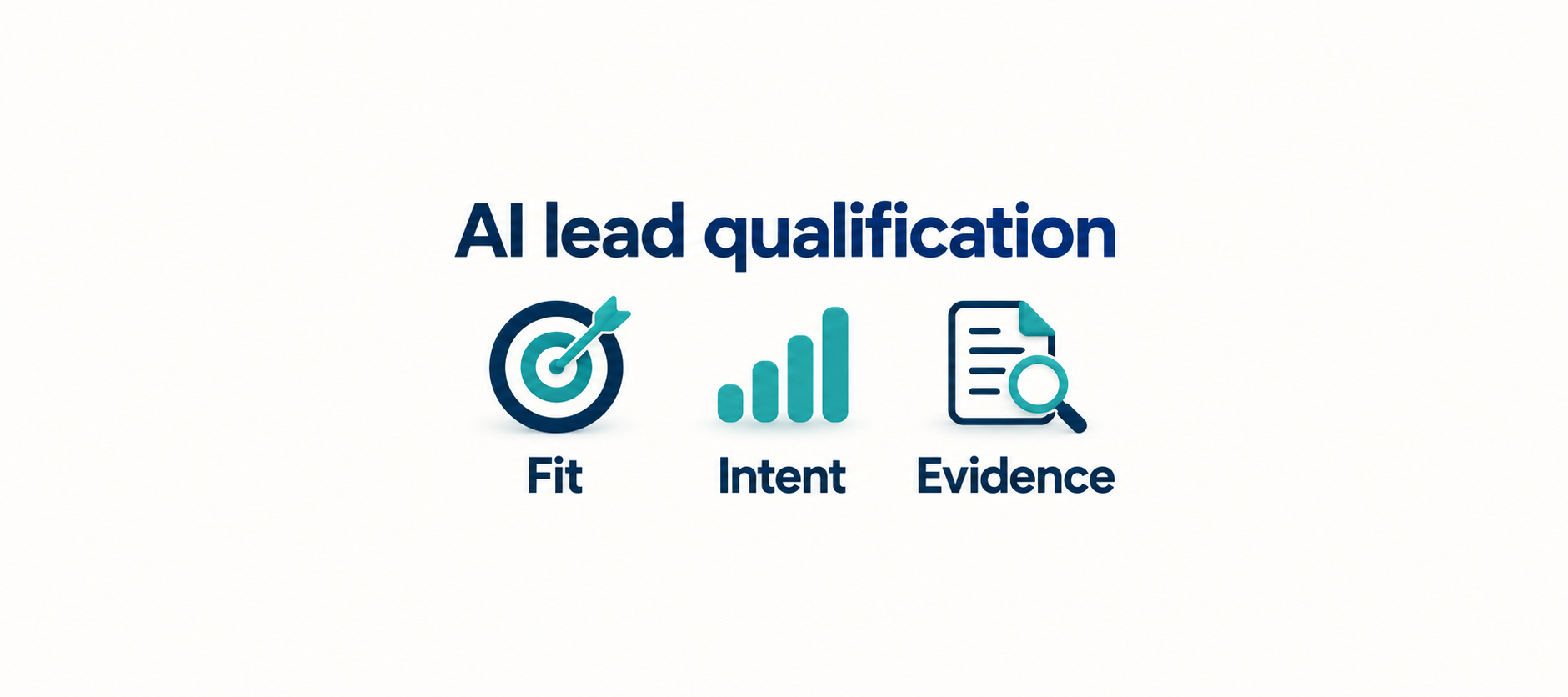
AI lead qualification uses artificial intelligence to gather relevant information, assess a prospect against your sales criteria, and recommend a next step. For a B2B team, a useful result explains why an account fits, what the buyer has actually said or done, what remains unknown, and who should act next.
A high score is not enough. A company can match your ideal customer profile without being ready to buy. A person can request information without controlling a purchase. Good qualification keeps those distinctions visible instead of turning incomplete research into a confident sales claim.
This guide shows how to build an evidence-led qualification workflow, test it with a fictional B2B example, and evaluate the software behind it. The examples and suggested evaluation rules are illustrative, not customer results or performance promises.
AI lead qualification vs. lead scoring: what is the difference?
Lead scoring prioritizes records. Lead qualification decides whether a specific next step is justified. A score may summarize company fit or engagement. Qualification also needs context: the problem, buying stage, exclusions, missing facts, and the standard a salesperson uses to accept a handoff.
HubSpot’s lead scoring documentation separates fit scores from engagement scores and also supports combined scores. That distinction is useful even if you use a different CRM: a good-fit company and an engaged contact are different kinds of evidence.
There are also different ways to use AI. A predictive model may estimate an outcome from historical records. An AI sales agent may research an account, interpret permitted CRM context, identify gaps, and prepare a recommendation. A rules engine may route records after a threshold is reached. Ask which approach a tool actually uses; the label “AI” does not establish its data requirements or reliability.
Define fit, intent, evidence, and exclusions separately
Before automating qualification, write the decision a human would make. “Find good leads” is too vague. “Identify companies our product can serve and prepare a sourced brief for a sales review” gives the work a usable boundary.
Fit: can you credibly help this account?
Use business-relevant criteria such as supported market, company type, use case, operating scale, and technical requirements. Distinguish a requirement from a preference. If you cannot support a required deployment environment, that is different from a company being slightly outside your preferred employee range.
Intent: what indicates a buying conversation?
A buyer describing a problem and asking to evaluate a solution is stronger evidence than a generic content interaction. A hiring announcement or expansion into a new market may justify further research, but it does not prove an active project, approved budget, or willingness to meet.
Evidence: how do you know, and how current is it?
Record the source and observation date beside each material claim. Mark facts as verified, inferred, missing, or conflicting. A company website may support its service offering; a buyer conversation may support its timeline. An old directory entry should not quietly overrule a recent buyer correction.
Exclusions: what prevents this action?
Check existing customers, active opportunities, duplicate records, unsupported use cases, and contact restrictions before outreach. A do-not-contact instruction should be a hard sending constraint, not a few negative points that other signals can outweigh. An existing account may need its current owner rather than a new-business sequence.
Frameworks can help structure the conversation. Salesforce explains BANT as budget, authority, need, and timing and highlights the importance of accurate, current information. Use these as questions to resolve. A senior title is not verified purchasing authority; a funding announcement is not a confirmed budget for your offer.
A practical AI lead qualification workflow
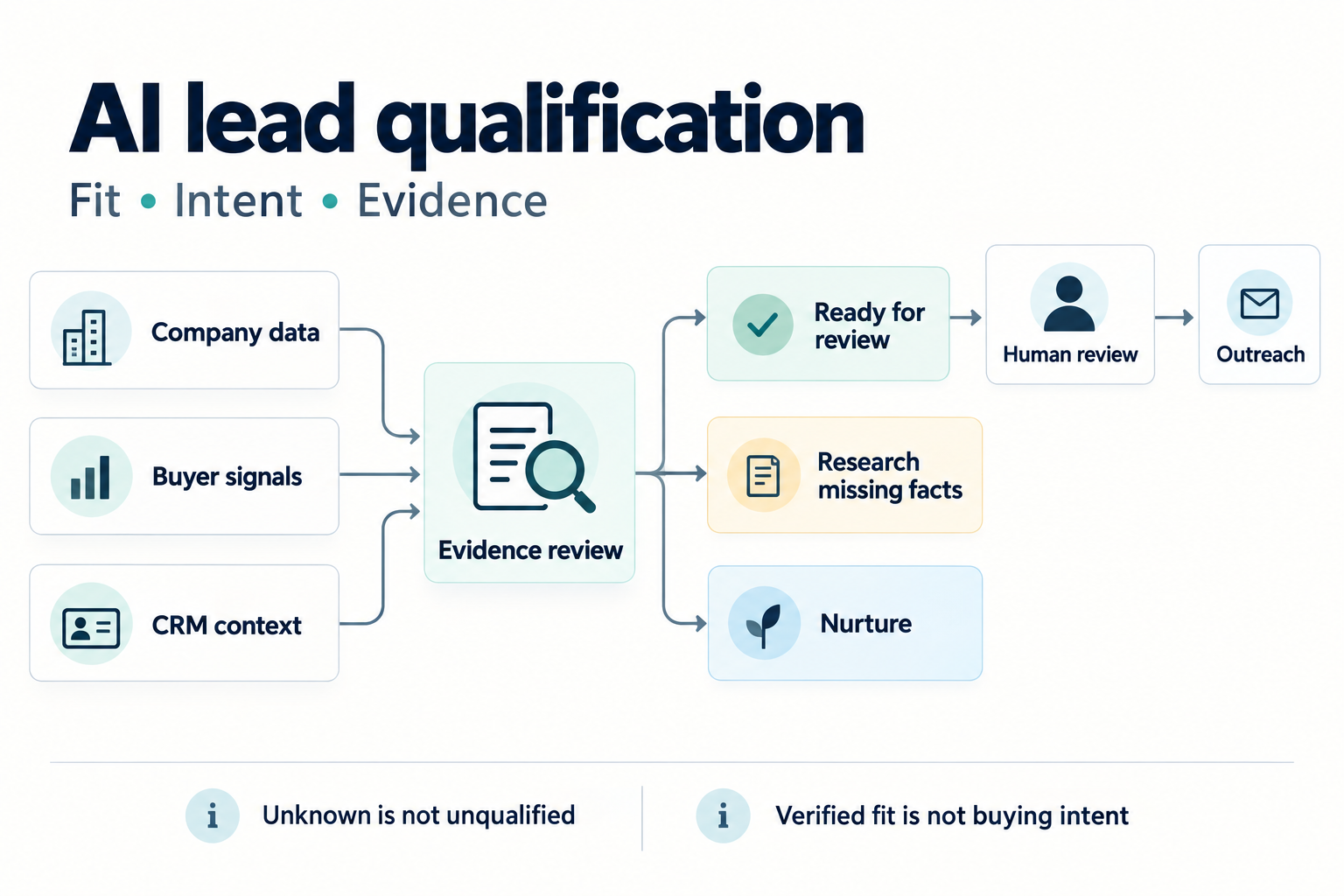
1. Set the qualification stage
Separate qualified for research, qualified for relevant outreach, and sales-accepted opportunity. An outbound prospect may be suitable for a carefully reviewed introduction before its budget is known. Calling that prospect sales-qualified would overstate the evidence.
For an inbound request, preserve what the person actually asked. A support question, partnership proposal, or job inquiry needs a different route from a product evaluation. Fast routing should not turn every contact into a sales opportunity.
2. Match the person and company to existing records
Resolve company domain, contact identity, account ownership, and previous conversations before creating another record. Check whether a prior rejection reflects a lasting mismatch or a temporary timing issue. Keep the original context available to the reviewer.
3. Research only the gaps that affect the decision
Use approved sources and connected tools to answer the outstanding qualification questions. Stop collecting information when it no longer changes the next step. Public business information and relevant, permitted CRM context are usually more useful than an indiscriminate dossier about a person.
4. Produce an evidence record
A qualification brief should contain:
- Account and contact: the matched company, relevant person, and current owner.
- Fit: criteria met, criteria not met, and the evidence behind each.
- Intent: the actual request or observed business signal, with its date.
- Unknowns: missing facts and contradictions that could change the decision.
- Disposition: the proposed route and the reason for it.
- Next action: a named owner, review requirement, and specific task.
5. Choose a disposition instead of forcing a binary answer
Qualify for the defined next step: enough evidence exists for the relevant action, subject to its approval rules.
Research: the account could fit, but a material fact is missing or conflicting. Unknown is not the same as unqualified.
Nurture or revisit: fit is credible, but the buyer has stated that the timing is later. Record the reason and an appropriate next review; do not invent a follow-up commitment.
Exclude or route elsewhere: a verified mismatch or restriction prevents this sales motion. Preserve the reason so the same account is not repeatedly reintroduced.
6. Review before enabling consequential actions
Test research and recommendations separately from sending messages, changing lifecycle stages, or booking meetings. A team may allow account research to run independently while holding outreach for review. Define what happens when evidence is weak, the buyer corrects a fact, or a tool fails.
An original B2B qualification example
Fictional scenario: a company sells onboarding software to multi-location service businesses. Its minimum fit requirements are a supported country and a centrally managed onboarding process. A sales review also needs a relevant operational problem and a clear next question.
Account A: its website confirms multiple locations in a supported country. A recent job post mentions operations expansion. There has been no buyer conversation. The account is worth researching, but central ownership of onboarding is unknown. The job post is a research signal, not proof of purchase intent.
Decision: research the operating model. If the fit is confirmed, prepare a relevant introduction for review. Do not label the account as having a budget or active evaluation.
Account B: a form submission describes inconsistent onboarding across locations and asks whether the product supports a required integration. Company fit is confirmed, but that integration has not been verified.
Decision: route the question to a product-informed salesperson. Preserve the buyer’s exact requirement and verify support before proposing a solution. Strong interest does not justify inventing a feature.
Account C: the company fits, but its account owner has recorded an active evaluation already in progress.
Decision: send the new context to the existing owner under the team’s rules. Avoid a duplicate prospecting sequence.
The useful output is not three impressive scores. It is three different, defensible next steps. This example reports no conversion result because no real campaign was run.
A qualification brief you can adapt
Use this instruction as a starting point for a research task. Replace the brackets with your actual rules and confirm that the necessary sources and permissions are available.
Task: Review these accounts for [specific sales motion] using [approved ICP] and [supported markets/use cases]. Check existing ownership, active opportunities, duplicates, and contact restrictions first.
Evidence: For each material criterion, provide the finding, source, observation date, and whether it is verified, inferred, missing, or conflicting. Keep company fit separate from buyer intent. Do not infer budget or authority from company size, funding, or job title alone.
Output: Recommend qualify, research, nurture, or exclude for the defined stage. Explain the reason, identify the most important open question, and name the proposed next action. Surface contradictions rather than resolving them by guesswork.
Boundary: Prepare the assessment for review. Do not send outreach, change sales stages, or create commitments unless those specific actions are approved under our team’s rules.
How to evaluate AI lead qualification software
Bring a small, representative set of example or anonymized records to a demo. Include a clear fit, a clear mismatch, an incomplete record, a conflicting signal, and an existing opportunity. Ask the provider to work through them rather than showing only ideal examples.
- Traceability: can a reviewer inspect the source behind a qualification claim?
- Uncertainty: can the system leave a material field unknown without inventing a value?
- Configuration: can your team distinguish preferences, hard requirements, and action restrictions?
- Context: does it check ownership and prior conversations before recommending a new motion?
- Controls: which actions need approval, and what happens when a connection is unavailable?
- Correction: can you revise an assumption and review how future work uses that change?
- Cost: what usage, data-provider, connector, and seat limits apply to your expected workload?
If you are comparing the broader research-to-outreach stack, use the AI BDR software buyer’s guide. Keep qualification quality as its own test; a tool’s ability to send more messages does not prove it chooses the right accounts.
Measure accepted decisions, not just processing speed
Begin with a reviewed sample and compare the system’s recommendation with a documented human assessment. Include rejected and ambiguous records, not only the leads that reached sales. Otherwise, you cannot see good prospects that were incorrectly excluded.
Useful measures include the share of recommended handoffs accepted by sales, incorrect exclusions found in a review sample, evidence completeness, time spent correcting records, and elapsed time to a useful next step. Define the denominator and qualification stage for each measure before comparing periods.
For example, “sales acceptance rate” can mean accepted handoffs divided by handoffs reviewed by sales. Report unresolved handoffs separately. It is not a close rate, and it does not establish revenue impact on its own.
Set a decision rule before the pilot: expand only if the recommendations are useful, the evidence is inspectable, and critical restrictions are respected. Fix incorrect facts, unwanted contact, and ownership conflicts before adding volume. HubSpot’s documentation similarly provides for testing records and previewing score distributions before enabling a score; your evaluation should include comparable checks whatever system you choose.
Where Vera fits in the qualification process
Vera is GrowthEffect’s AI sales agent. Its current product scope includes researching accounts, working with connected tools and CRM context, preparing outreach, and carrying approved sales work forward. Company Brain supplies business context such as your ICP, positioning, products, and sales approach.
In the outbound workflow, Vera can investigate account fit and business signals, identify relevant people, and prepare personalized LinkedIn and email outreach. You choose the accounts, sender identities, and approval boundaries. Research can proceed while outreach waits for review.
Vera’s reusable methods and automations can help carry qualification instructions and useful corrections into later work. That is working context your team can review and refine; it is not a promise that every interaction retrains a predictive model or automatically improves conversion.
To evaluate fit, book a Vera demo with your qualification criteria and a few example or anonymized records. Ask to see the evidence, handling of unknowns, and approval step. Review current Vera plans and usage allowances against the workflow you want to run.
Frequently asked questions
Can AI qualify leads without historical conversion data?
An agent can assess records against explicit business criteria and research evidence without building a predictive model from your conversion history. A predictive scoring product may have specific training-data requirements. Confirm which method and minimum data the provider needs.
Does an AI-qualified lead mean a sales-qualified opportunity?
No. Always name the stage. An account can be qualified for research or outreach while its need, budget, buying process, or timing remains unconfirmed. A sales-accepted opportunity requires the evidence and acceptance rules your team has agreed.
What should happen when information is missing?
Record the gap and choose the least consequential useful next step: research, ask a relevant question, or send the record for review. Do not treat a missing budget as a confirmed lack of budget or turn an inferred need into a buyer statement.
Sources and product information checked on October 11, 2026. This guide provides a practical operating framework; results depend on your data, market, process, and execution.
Work with GrowthEffect AI
GrowthEffect AI helps B2B teams automate inbound response, outbound pipeline generation, qualification, CRM updates, and sales handoff.